 Experience shared.
Prevention informed.
The reason behind our research
Why it matters
Motorcycling brings freedom, enjoyment and connection. We want more people to enjoy those benefits without a collision changing their lives.
To prevent injuries effectively, we need to understand the whole picture: who is hurt, what happens afterwards and where change could make the greatest difference.
Published national evidence · Great Britain, 2025
A small share of traffic.
A much larger share of the harm.
Motorcycles account for around 1% of traffic, but 25% of road deaths.
Traffic measured in vehicle miles.Motorcycle riders and passengers killed in reported collisions.
Estimated seriously injured motorcycle riders and passengers.
Adjusted estimate from police-reported collisions.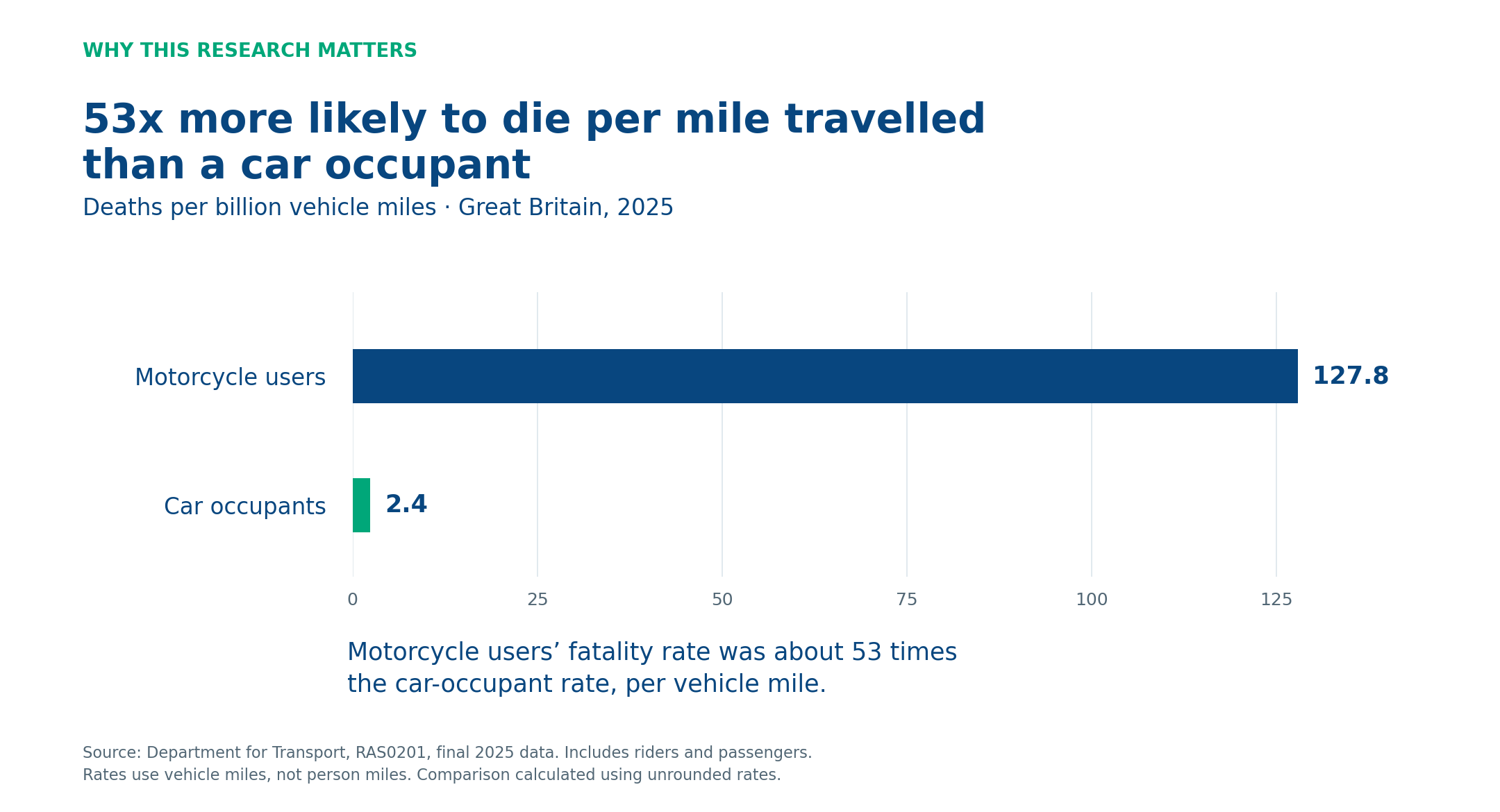
Beyond the collision
A collision changes
more than one life.
Recovery can continue long after someone leaves hospital. Families may become carers. Working lives, relationships and independence can change.
Emergency care is only one part of the story. Understanding the effects on people, public services and communities will help us see the full value of preventing an injury.
Questions emerging from our local work
What might the current picture be missing?
Two pieces of work in Dorset are helping shape our questions. Both are being written up for submission to peer-reviewed journals. The findings below are preliminary and have not yet been peer reviewed.
Injuries beyond the police statistics?
Early MIPnet work in Dorset suggests that around 60% of injured people in the local work self-presented to hospital after a motorcycle collision. The emerging analysis suggests a substantial share of injuries may be absent from the DfT figures.
DfT collision statistics rely on police records. People who attend hospital can be missed if their collision is not reported to, or recorded by, the police. Police attendance at the scene is not required for a STATS19 report.
Our question: what more could we learn by bringing hospital and collision records together?
The 60% figure describes the local work, not a national estimate. Self-presentation alone does not establish that an injury is missing from STATS19; this needs comparison of the records.
Opportunities to prevent serious crashes?
DocBike work with Dorset Police, the Trauma Audit and Research Network and the Wessex Trauma Network suggests that up to 80% of the most serious crashes examined may have been avoidable through effective awareness and education.
This offers a promising direction for research: understanding which opportunities were present, how people could recognise them and which approaches make a difference in practice.
Our question: how can we turn potential opportunities into effective prevention?
This is an assessment of potential avoidability in the crashes examined. It does not demonstrate that an education programme reduces crashes by 80%.
We will share the methods, findings and limitations as this work progresses towards publication. Follow our publications and findings →
Why research is needed now
Better understanding. More useful action.
The national figures show the scale of the harm. The local work points to gaps in what we know and opportunities worth testing. MIPnet brings the people and perspectives together to take those questions forward.
Connect the evidence
Bring information about collisions, treatment and recovery together to understand injuries that individual datasets may miss.
Listen to lived experience
Learn from riders and families about the effects on everyday life, including people whose experiences are less often heard.
Test approaches to prevention
Use better evidence to guide and evaluate practical ways to prevent collisions and reduce the harm they cause.
Your experience can help shape this work.
We welcome riders, families and people affected by motorcycle collisions.
Sources and evidence notes
- Department for Transport: reported road casualties, Great Britain, final results 2025 — road user type. National figures above relate to Great Britain, not the whole UK, and include riders and passengers.
- DfT road casualty tables, including RAS0201. The approximately 53-fold comparison uses unrounded deaths-per-billion-vehicle-miles rates. Serious-injury figures are adjusted estimates.
- DfT STATS19 forms and STATS20 guidance. Eligible injury collisions reported to police within 30 days can be recorded even when police did not attend the scene. Hospital attendance alone does not automatically create a STATS19 record.
- Preliminary Dorset findings: MIPnet and DocBike work described by Dr Ian Mew, September 2026. Manuscripts in preparation; not yet peer reviewed. Published papers will be linked here when available.